⚠ 本文为英文原文,暂无中文版。
Stocks / Crypto / Forex: Backtest & Live Trading Report (2025)
Three lines: XPEV daily backtest (12.7M profit, 38% annualized), BTC/ETH futures trend strategies (47,500 USDT live test, annualized return/drawdown 6.05 / 7.32) and CEX–DEX spread arbitrage (no-leverage return/drawdown 376); plus ETH/SOL grid live trading on Ubuntu, MT5 Python development and FinGPT news sentiment exploration. Ongoing live records live in the Track Record section.
Combined backtest and live-trading report across stocks, crypto and forex. This English version has six parts; ongoing live records are presented in the Track Record section.
I. Nasdaq Stocks: XPEV Daily Backtest
Nasdaq stocks move far more violently than A-shares, so a daily timeframe is needed to capture the significant opportunities. Tested on XPeng Motors (XPEV.NASDAQ) with a 0.06% commission (low frequency, slippage minor), long-only, 10 million principal:
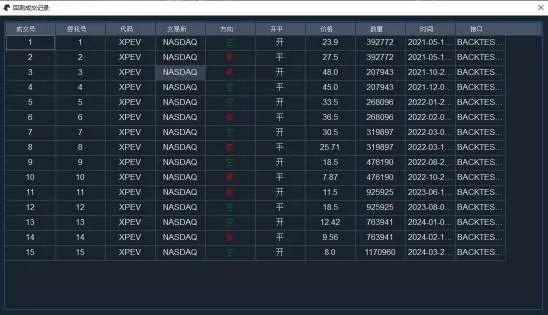
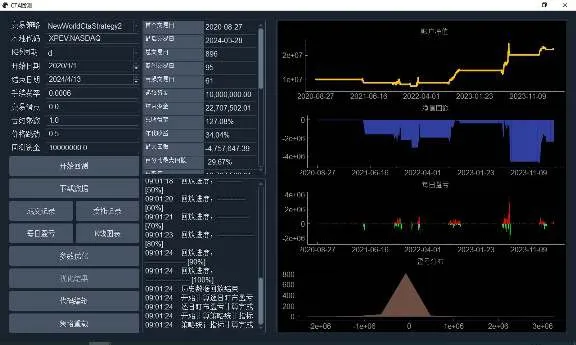
XPEV.NASDAQ, 10 million principal, daily chart from August 27, 2020 to November 9, 2023: total profit ≈ 12.7 million in 15 trades; annualized return 38%; maximum drawdown 29%; annualized return / max drawdown = 1.2; about 5 trades per year. For a single-stock daily strategy these results are quite good; adding more stocks should improve them further.
II. Crypto Trend-Following Strategies
The crypto market’s high volatility suits beta capture; given the huge universe, testing focuses on the largest assets (BTC/USDT, ETH/USDT) in futures form, which allows position reduction.
Fees: on Binance/OKEx, futures market orders cost 0.05% and limit orders 0.02%, plus a 0.02% funding component when futures trade at a premium — an effective ~0.05% total; slippage on large liquid exchanges is minor. Total assumed cost: 0.05% including slippage.
Backtest
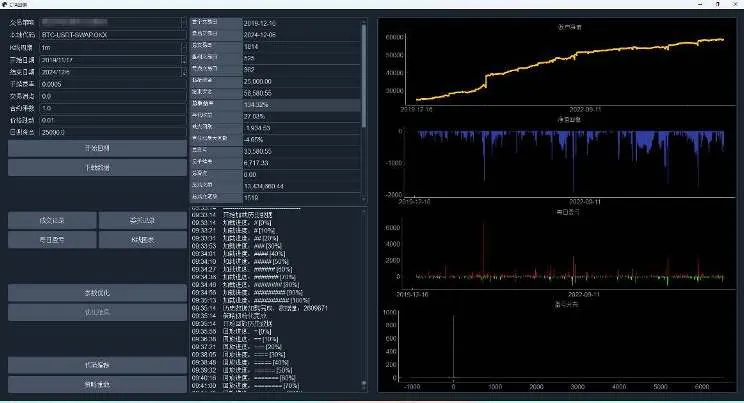
BTC/USD — 25,000 USDT principal, 1-hour bars, 2019-11-19 → 2024-12-06: profit ≈ 58,580 USDT over 1,519 trades; annual profit 11,716 USDT; max drawdown 1,934 USDT; annualized return/drawdown = 6.05; 303.8 trades/year. ETH/USD — same setup: profit ≈ 86,326 USDT over 2,732 trades; annual profit 17,265 USDT; max drawdown 2,357 USDT; annualized return/drawdown = 7.32; 546.4 trades/year.
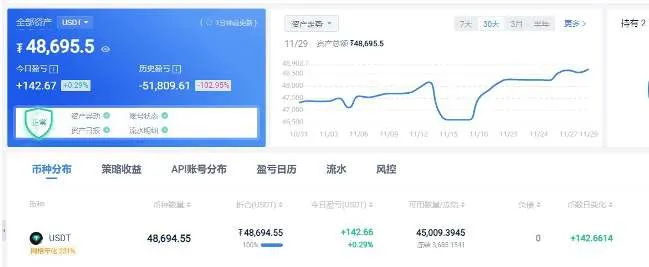
Overall BTC and ETH performance is similar, with ETH offering better returns and a better return/drawdown ratio. Live trading with 47,500 USDT across the two pairs was up about +2.5% over the most recent month despite a recent drawdown; ongoing records are in the Track Record section.
III. CEX–DEX Spread Arbitrage
Common arbitrage styles (spot–futures, cross-market between major CEXs) are crowded: with meaningful slippage and high frequency, profits shrink or turn negative. The focus here is instead arbitrage between centralized major exchanges and a decentralized exchange.
Setup: Binance vs. an established DEX; maker fee 0.02%, taker fee 0.05%. Orders rest at the second-best bid/ask; test cost set to 0.03%. Positions are held during both positive and negative spreads; when the spread flips sign, both legs close and opposite orders open.
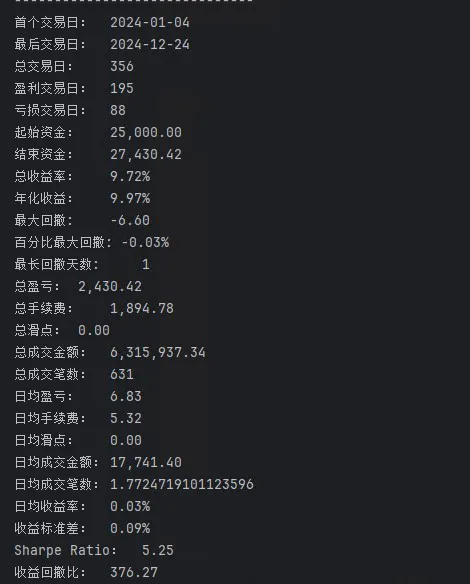
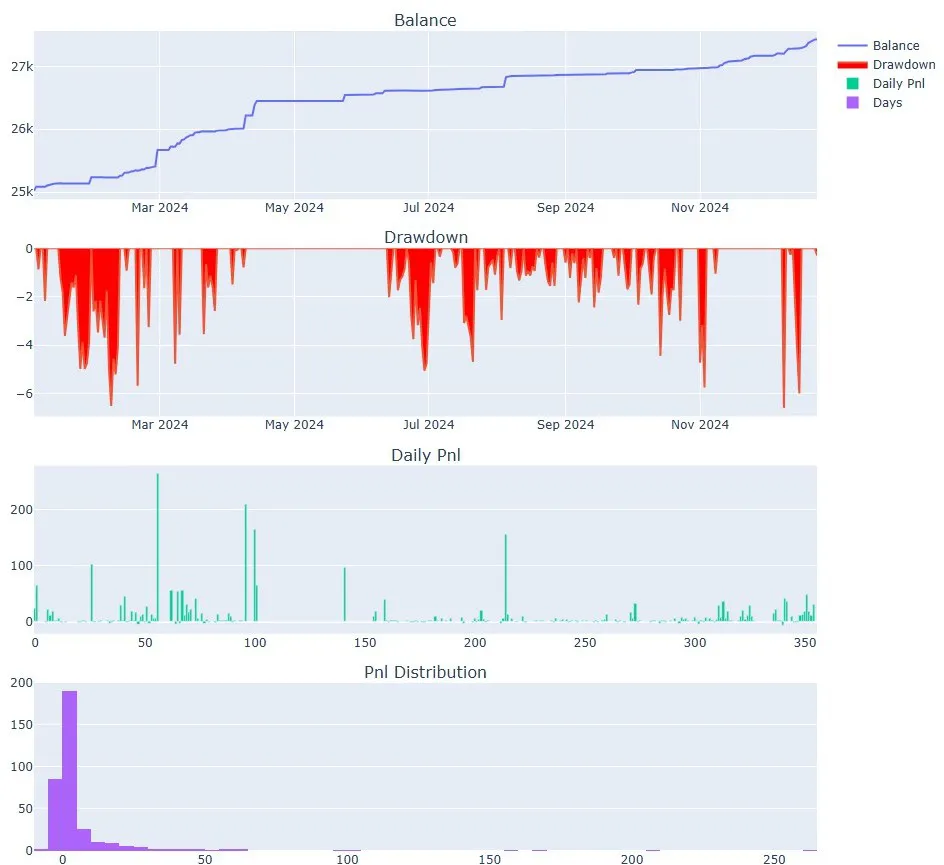
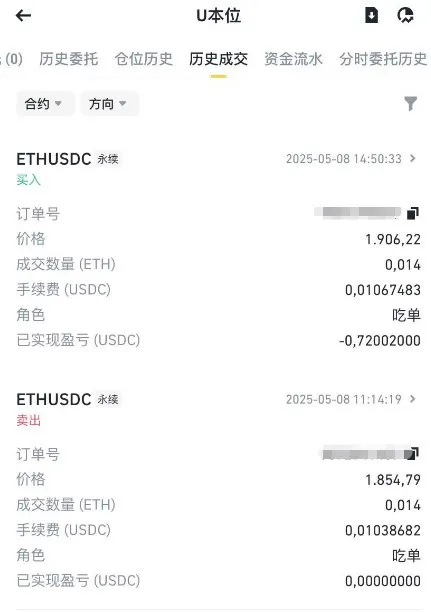
Live validation: a “leg break” later occurred in live trading — caused by Binance’s 20-USDC limit, which left limit orders unfilled when triggered. Fixed; live trading now runs normally. Capital will be scaled up gradually to find maximum capacity — currently estimated at ≈ 1 million USDT combined across major cryptocurrencies.
IV. Strategy Development & Ubuntu Live Trading (Grid)
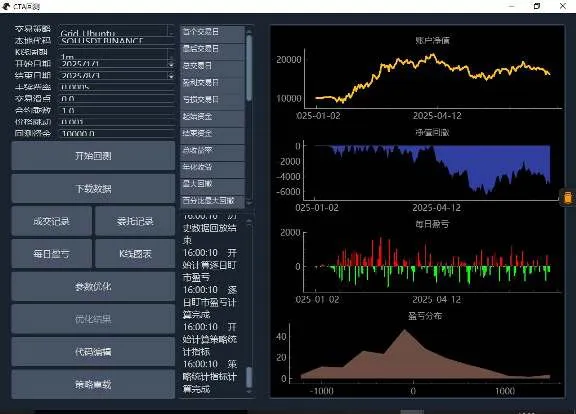
Dedicated ETH and SOL grid strategies run UI-less live trading on Ubuntu; the system is monitored via operation logs and trade records, which sharply reduces CPU and memory usage.
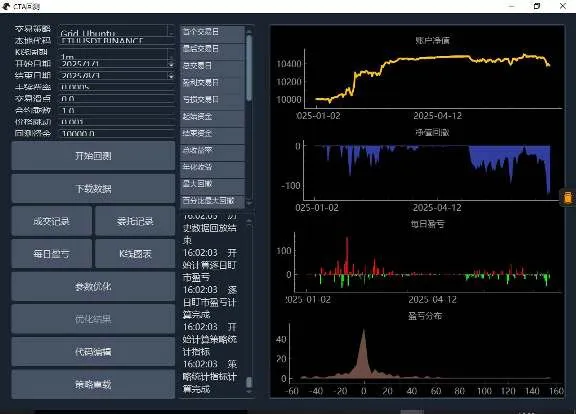
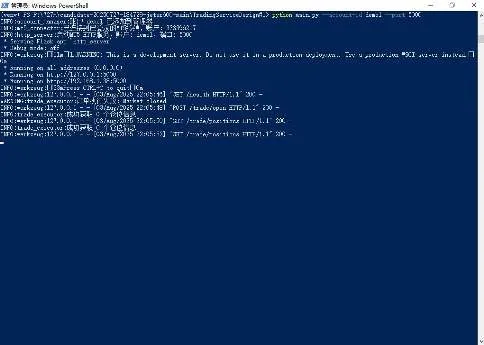
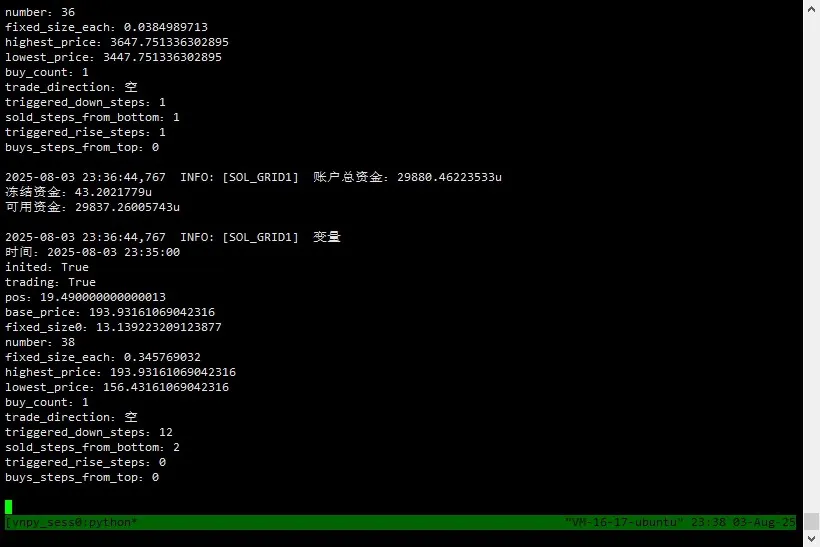
V. Python System Development for MT5
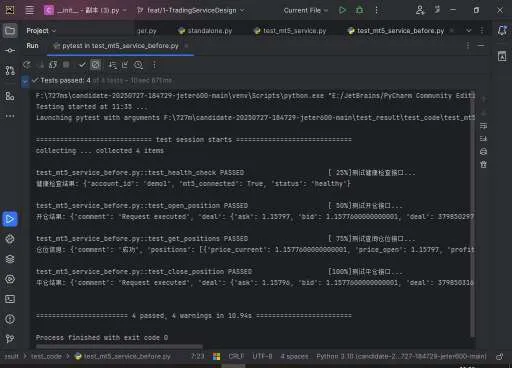
MT5 is an external trading platform; Python development goes through its library. Design and testing details:
- Establishing the connection to the MT5 interface:
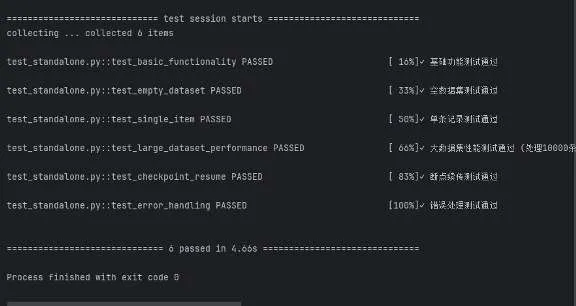
- Opening/closing positions and viewing open positions; memory optimization, parallel computing, exception handling and performance tuning for large-scale tests:
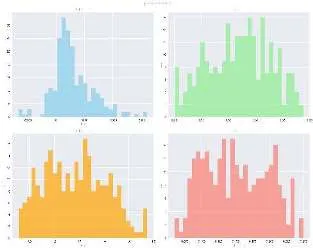
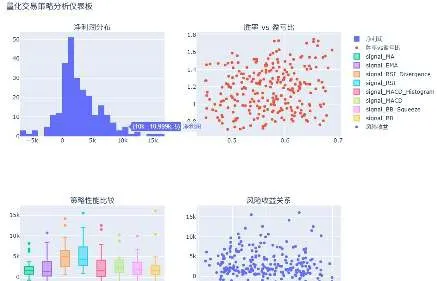
- Correlation analysis across multi-parameter, multi-return-metric runs — heat maps, performance reports, strategy comparison and a quant strategy analysis dashboard:
VI. FinGPT News Sentiment Analysis
Exploring a model that predicts capital flows from macro news sentiment; step one is building the sentiment model. Since the news is financial, FinGPT was installed to call the ProsusAI/finbert model from Hugging Face (a small model suitable for testing): news tokens are converted to numeric IDs and length-normalized, passed through a multi-layer Transformer, and mapped to three labels — positive / negative / neutral. The model was fine-tuned on financial sentiment data to understand terms like “interest rates”, “volatility” and “tension”.
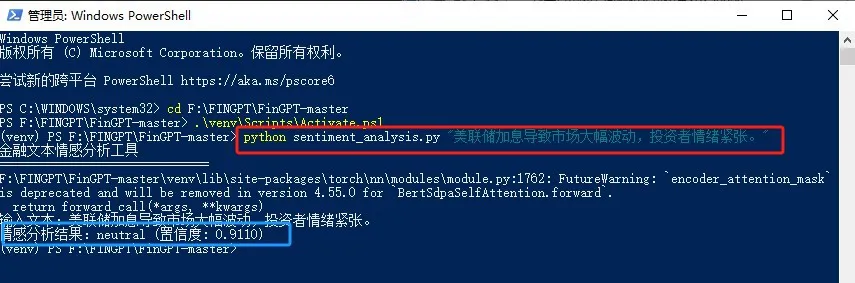
Input: “The Fed’s interest rate hike has caused significant market volatility, and investor sentiment is tense.” — the model outputs the corresponding sentiment classification.
Backtest and live results are based on historical data and fixed fee/slippage assumptions and do not constitute investment advice.